
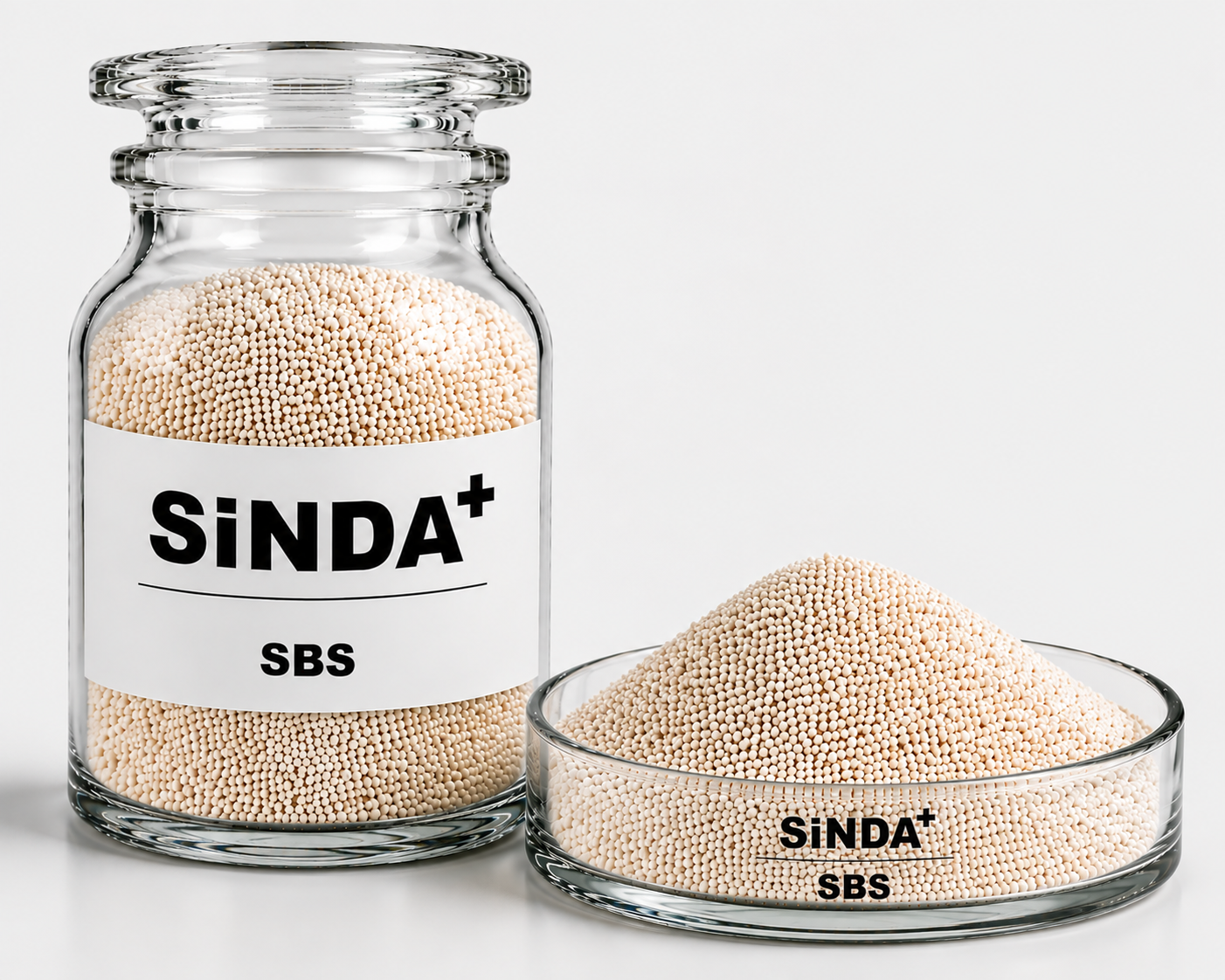
SBS
SBS (Styrene-Butadiene-Styrene) supplied by SiNDA as a styrenic block copolymer for industrial manufacturers requiring elastomeric properties, thermoplastic processability, and application-specific polymer performance.
- Polymer Type
- Key Performance
- Packaging
- Open this page on mobile
Product Overview
Modern industrial formulations require polymers that combine flexibility, elasticity, mechanical strength, and efficient thermoplastic processing. Styrenic Block Copolymers are widely selected where manufacturers need rubber-like performance together with the processing advantages of thermoplastic materials.
SBS (Styrene-Butadiene-Styrene) is a Styrenic Block Copolymer (SBC) supplied by SiNDA through qualified international manufacturing partners for industrial polymer modification and specialty manufacturing applications.
SBS is composed of polystyrene blocks and elastomeric polybutadiene segments arranged in grade-dependent block-copolymer architectures. This molecular structure can provide a combination of mechanical strength, elasticity, flexibility, and thermoplastic processability for a range of polymer-modification applications.
At normal service temperatures, the styrene domains act as physical crosslinking points, supporting structural integrity and dimensional stability. The butadiene phase provides elastomeric behavior, helping the polymer deliver flexibility, elongation, and resilience.
Unlike chemically crosslinked rubber, SBS can soften at elevated temperatures and be processed using thermoplastic manufacturing techniques, while recovering elastomeric characteristics after cooling.
Different SBS grades may vary in molecular weight, styrene content, linear or radial architecture, diblock content, melt flow behavior, and mechanical performance. Product selection should therefore be based on the customer’s manufacturing process, formulation design, and required finished-product characteristics.
SiNDA supplies SBS for industrial applications with available technical documentation, commercial shipment traceability where applicable, and international sourcing and supply support.
Key Benefits
- Styrene-Butadiene-Styrene block copolymer technology
- Thermoplastic elastomer performance
- Elastomeric flexibility and recovery
- Grade-dependent mechanical properties
- Thermoplastic processing capability
- Suitable for polymer modification
- Multiple grade architectures for different application requirements
- Available technical documentation
- Coordinated commercial sourcing
- International supply through SiNDA
Operational Applications
SBS is intended for industrial formulations requiring elastomeric modification, flexibility, thermoplastic processability, and application-specific mechanical properties.
Typical applications include:
- Polymer modification
- Adhesive manufacturing
- Sealant formulations
- Bitumen and asphalt modification
- Footwear compounds
- Rubber and plastic compounding
- Impact modification
- Construction materials
- Specialty industrial compounds
The suitability of SBS should be evaluated according to the target application, processing temperature, polymer architecture, formulation components, and finished-product performance requirements.
Technical Overview
SBS is a Styrene-Butadiene-Styrene block copolymer belonging to the Styrenic Block Copolymer (SBC) family.
SBS contains rigid polystyrene blocks and elastomeric polybutadiene segments arranged in architectures that can vary by grade. The styrenic domains provide physical crosslinking and contribute to mechanical integrity, while the butadiene phase provides elasticity and flexibility.
The resulting polymer combines characteristics of both thermoplastics and elastomers, enabling SBS to be processed using conventional thermoplastic equipment while maintaining rubber-like properties after cooling.
Important grade variables include:
- Styrene content
- Molecular weight
- Molecular-weight distribution
- Linear or radial structure
- Diblock content
- Melt flow characteristics
- Solution viscosity
- Hardness
- Tensile properties
- Elongation
Actual performance depends on SBS grade selection and finished formulation design.
Performance Characteristics
Elastomeric Performance
SBS derives its rubber-like elasticity and flexibility primarily from the elastomeric polybutadiene phase.
This can support:
- High elongation
- Elastic recovery
- Flexibility
- Resilience
- Improved impact behavior
Final mechanical performance depends on polymer grade, formulation, and processing conditions.
Thermoplastic Processability
The physical crosslinking structure of SBS softens at elevated processing temperatures, allowing the polymer to be processed using thermoplastic manufacturing equipment.
This supports:
- Efficient mixing
- Extrusion processing
- Injection molding
- Hot-melt applications
- Polymer compounding
Mechanical Strength
The styrenic domains contribute to the mechanical integrity of SBS formulations.
Depending on grade and formulation, SBS can provide:
- Tensile-property contributions
- Dimensional stability
- Structural reinforcement
- Grade-dependent mechanical performance
Formulation Flexibility
SBS is available in multiple grades and polymer architectures, allowing manufacturers to select products according to specific processing and performance requirements.
Compatibility & Limitations
SBS is compatible with a range of polymers, process oils, resins, fillers, and other industrial formulation components, depending on the specific grade and application.
Compatibility should be evaluated with:
- Hydrocarbon resins
- Process oils
- Bitumen systems
- Polyolefins
- Plasticizers
- Fillers
- Tackifiers
- Other elastomeric polymers
SBS is not suitable for every environment. The polybutadiene segment contains unsaturation and may be sensitive to prolonged exposure to heat, oxidation, ozone, and UV radiation unless the formulation includes appropriate stabilization.
For applications requiring enhanced resistance to weathering, oxidation, or elevated temperatures, hydrogenated styrenic block copolymers such as SEBS may be more appropriate.
Selection Guidance
SBS may be suitable for manufacturers seeking:
- Elastomeric flexibility
- Thermoplastic processability
- Application-specific mechanical properties
- Polymer modification capability
- Adhesive and sealant performance
- Bitumen modification
- Flexibility in industrial compound development
Before selecting an SBS grade, manufacturers should evaluate:
- Target application
- Styrene content
- Polymer architecture
- Molecular weight
- Melt flow behavior
- Processing temperature
- Required hardness
- Tensile and elongation targets
- Environmental exposure
- Finished-product performance requirements
Product suitability should be confirmed through laboratory and production trials.
Compliance & Technical Documentation
SiNDA supplies SBS with available technical and commercial documentation to support industrial evaluation, supplier qualification, and procurement.
Available documentation may include:
- Technical Data Sheet (TDS)
- Safety Data Sheet (SDS)
- Certificate of Analysis (COA)
- Batch-specific quality documentation
- Storage and Handling Recommendations
- Commercial shipment documentation
- Export Documentation
Published typical values should not be treated as guaranteed specifications unless confirmed by the manufacturer’s current TDS and batch-specific COA.
Why Choose SiNDA
SiNDA supplies styrenic block copolymers through qualified international manufacturing partners, supporting industrial manufacturers with product access, available technical documentation, sourcing coordination, and commercial supply.
Key advantages include:
- Qualified international manufacturing sources
- Available technical documentation
- Coordinated commercial sourcing
- Batch traceability
- Support for supplier qualification
- Technical communication support
- International logistics capability
- RFQ and procurement assistance
Frequently Asked Questions
What is SBS?
SBS is a Styrene-Butadiene-Styrene block copolymer belonging to the Styrenic Block Copolymer family and combining thermoplastic processability with elastomeric performance.
Is SBS a thermoplastic or rubber?
SBS is classified as a thermoplastic elastomer. It behaves like rubber under normal service conditions but can be processed like a thermoplastic at elevated temperatures.
What are the main applications of SBS?
Typical applications include adhesives, sealants, polymer modification, bitumen modification, footwear compounds, rubber and plastic compounds, and specialty industrial materials.
What is the difference between linear and radial SBS?
Linear and radial SBS grades have different molecular architectures, which can influence processing behavior, viscosity, mechanical properties, and formulation performance.
Is SBS resistant to oxidation and weathering?
SBS has limited resistance to prolonged oxidation, ozone, UV exposure, and high-temperature aging because of unsaturation in the butadiene block. Stabilization may therefore be required.
What documentation is available?
Depending on the manufacturing source and grade, SiNDA may provide TDS, SDS, COA, batch documentation, storage guidance, and export documentation.
TDS
| Property | Test Method | Typical Value / Specification |
| Product Name | — | SBS |
| Full Chemical Name | — | Styrene-Butadiene-Styrene |
| Polymer Family | — | Styrenic Block Copolymer (SBC) |
| Product Type | — | Thermoplastic Elastomer (TPE) |
| Commercial Brand | — | SiNDA |
| Manufacturer | Manufacturer Documentation | Qualified International Manufacturing Partner |
| Supplier & Distributor | — | SiNDA |
| Polymer Architecture | Manufacturer Declaration | Linear or Branched / Radial — Grade Dependent |
| Physical Form | Visual | Porous Pellets, Powder or Crumb — Grade Dependent |
| Appearance | Visual | Clear/Natural to Off-White Polymer |
| Polystyrene Content | Manufacturer Method | 29–32 wt.% |
| Butadiene-Based Fraction | By Difference | Approx. 68–71 wt.% |
| Molecular Weight | GPC / Manufacturer Method | Grade Dependent; typically 138–162 kg/mol for selected linear grades |
| Triblock Content | Manufacturer Method | Grade Dependent; up to ~90% for selected grades |
| Specific Gravity | ISO 2781 | Approx. 0.94 |
| Bulk Density | ASTM D1895 Method B | Approx. 0.40 kg/dm³ |
| Melt Flow Rate @200°C / 5 kg | ISO 1133 | Approx. 1 g/10 min |
| Shore A Hardness | ISO 868 / ASTM D2240 | 70–75 |
| Tensile Strength | ISO 37 | 27–33 MPa |
| Elongation at Break | ISO 37 | 820–1,000% |
| 300% Modulus | ISO 37 | 2.5–4.8 MPa |
| Volatile Matter | Manufacturer Method | ≤0.30 wt.% |
| Total Extractables | Manufacturer Method | ≤1.0–1.4 wt.% |
| Ash Content | ISO 247 | 0.1–0.4 wt.% for typical dusted pellet grades |
| Antioxidant Content | Manufacturer Method | Approx. 0.14–0.16 wt.% |
| Solution Viscosity | Manufacturer Method | Grade and Test-Condition Dependent |
| Oil Content | Manufacturer Declaration | Oil-Free or Grade Dependent |
| Processing Methods | — | Extrusion, Compounding, Hot-Melt Processing and Polymer Modification |
| Recommended Applications | — | Adhesives, Sealants, Bitumen Modification, Polymer Compounds, Coatings and Specialty Industrial Applications |
| Packaging | Supplier Declaration | SiNDA Commercial Packaging |
| Storage Conditions | — | Store in a Cool, Dry, Ventilated Area Away from Heat, Sunlight and Contamination |
| Shelf Life | Manufacturer Documentation | Subject to Manufacturer Confirmation |
Final Technical Summary
SBS (Styrene-Butadiene-Styrene) is a styrenic block copolymer supplied by SiNDA for polymer modification, adhesives, bitumen modification, compounding, and related industrial applications. Its elastomeric properties and thermoplastic processability depend on polymer architecture, grade selection, formulation design, and processing conditions.
Looking for SBS with available technical documentation and international supply support?
Contact the SiNDA technical team for pricing, product availability, samples, technical information, and RFQ assistance via WhatsApp.
For direct and secure purchases with guaranteed quality, contact our experts now and benefit from free consultation.