
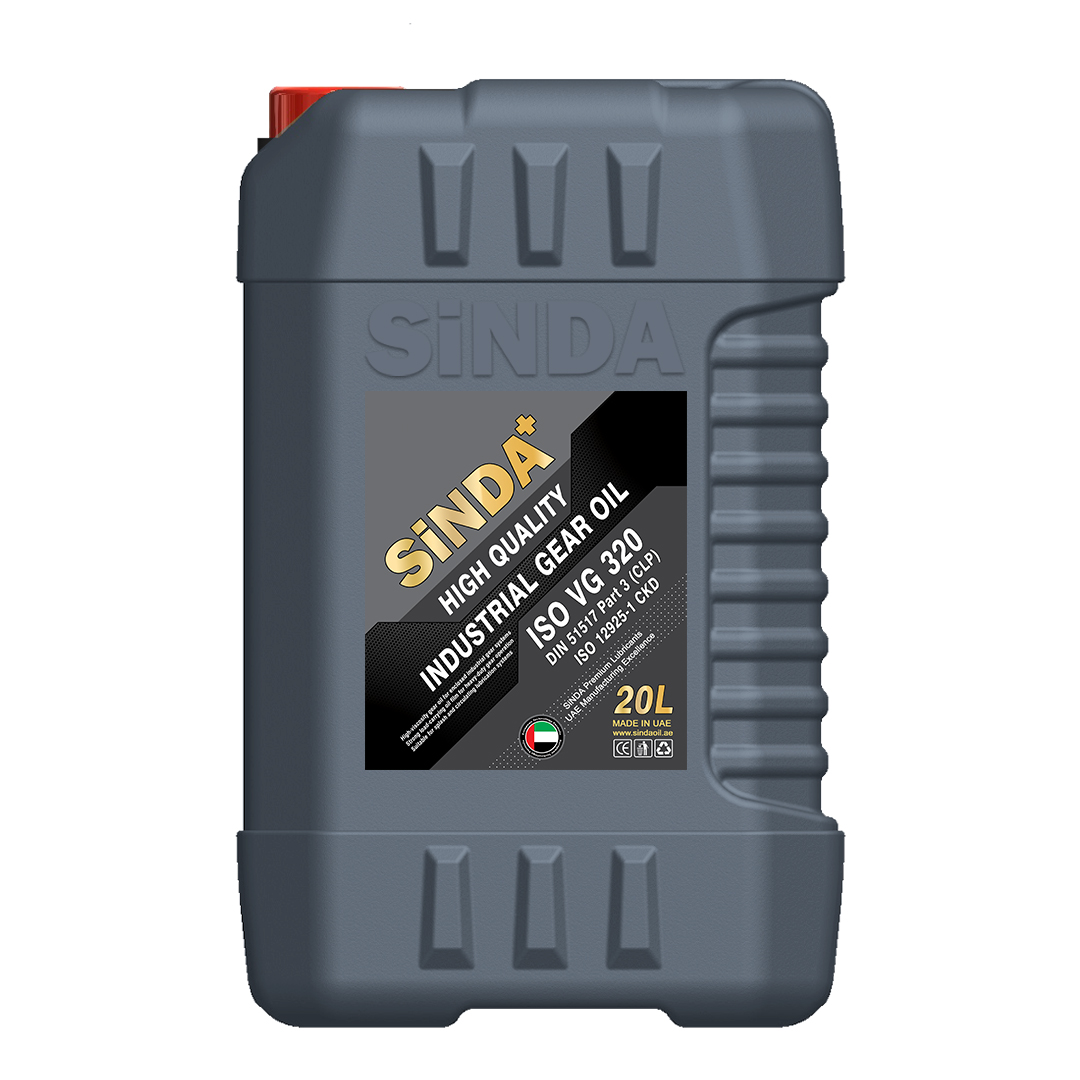
Gear Oil 320
ISO VG 320 lubricant for enclosed industrial gearboxes specifying this grade. Confirm documented CLP performance, gearbox compatibility and startup and operating-viscosity limits.
- ISO
- Packaging
- Production
- Open this page on mobile
Product Overview
SiNDA Gear Oil 320 is an industrial gear lubricant formulated for enclosed gearbox systems operating under moderate-to-high mechanical loads and stable operating temperatures. The product is classified within the ISO VG 320 viscosity range, which is typically selected when lower-viscosity gear oils cannot maintain sufficient film thickness under load.
In practical operation, this viscosity range supports continuous load transfer between gear teeth, bearings, and sliding surfaces while minimizing direct metal-to-metal contact, surface fatigue, and premature wear. Gear Oil 320 is commonly applied in industrial environments where long-term reliability and controlled maintenance intervals are prioritized over short-term cost optimization.
Operational Applications
Gear Oil 320 is typically used in enclosed industrial gearboxes equipped with spur, helical, bevel, or worm gears operating under steady load conditions and moderate rotational speeds. Within the broader category of industrial lubricants, this viscosity grade is commonly selected for applications where sustained load capacity and stable oil film thickness are required.
Common application scenarios include:
- Conveyor drive gearboxes in continuous production lines
- Industrial reducers operating under constant torque
- Gear systems exposed to moderate contamination or dust
- Auxiliary gearbox units in heavy industrial equipment
Example:
In a conveyor gearbox handling constant material flow, Gear Oil 320 provides sufficient oil film thickness to limit micropitting and surface fatigue without introducing excessive internal drag that could elevate operating temperatures.
Technical Specifications (Overview)
Gear Oil 320 is formulated within the ISO VG 320 viscosity classification, providing a thick and stable lubricating film suitable for enclosed gear systems operating under continuous or moderate-to-high load.
Confirm the published DIN 51517-3 (CLP) performance claim against the current formulation documentation and is suitable for standard industrial reducers where load-carrying capacity, oxidation stability, controlled foaming, and predictable long-term behavior are required.
Defined operating temperature limits—including pour point and flash point values—are provided in the official product datasheet to ensure correct application and safe operation.
Performance Characteristics
Load-carrying capability
The viscosity profile and EP performance support stable separation of heavily loaded gear surfaces, reducing the risk of scuffing under sustained torque.
Wear and surface protection
Controlled oil film thickness limits abrasive wear and surface fatigue, contributing to extended component life and reduced unplanned downtime.
Thermal and oxidation stability
The formulation resists viscosity breakdown and sludge formation during prolonged operation at elevated temperatures.
Foam and air release behavior
Low foaming tendency supports consistent lubrication, particularly in circulating lubrication systems.
Operational outcome: predictable gearbox behavior, extended oil service life, and reduced maintenance interventions.
Compatibility & Limitations
Confirm gearbox, metal and seal compatibility against the equipment manual and current formulation TDS; worm gears and yellow-metal components may require specific compatibility evidence.
Not recommended when:
- Operating temperatures regularly approach cold-start limits
- Gear systems operate at very high rotational speeds requiring lower viscosity
- The required shock-load performance or OEM approval is not documented for the supplied formulation
Understanding these limits helps avoid overheating, excessive energy losses, or lubrication starvation.
Selection Guidance
Choose Gear Oil 320 when:
- Gearboxes operate under continuous or moderate-to-high load
- Lighter gear oils do not provide sufficient oil film strength
- Operating temperatures are stable and suitable for this viscosity range
Consider alternative grades when:
- Startup viscosity falls outside the gearbox manufacturer’s permitted range
- Shock-load or extreme-load requirements exceed the documented performance of the supplied formulation
Rule of thumb:
Investigate abnormal wear, contamination, alignment, oil condition and the equipment specification before changing viscosity. Increasing grade is not automatically the correct remedy.
Compliance & Standards
Gear Oil 320 aligns with widely recognized industrial gearbox lubricant classifications, including:
- ISO viscosity classification system
- DIN 51517-3 (CLP) performance category
- General AGMA industrial gearbox performance expectations
Request the exact DIN, ISO performance category and AGMA reference supported by current documentation. A viscosity grade or a general standards reference alone does not establish application suitability.
Industrial FAQ
Is Gear Oil 320 suitable for all industrial gearboxes?
No. Use it only when the equipment specifies ISO VG 320 and the formulation meets the required performance and compatibility criteria.
Can Gear Oil 320 be used in circulating lubrication systems?
Yes, provided the system is designed for this viscosity range and appropriate filtration is in place.
What happens if viscosity selection is too high?
Excessive viscosity can increase internal friction, raise operating temperature, and reduce overall energy efficiency.
Can Gear Oil 320 replace Gear Oil 220 in an existing gearbox?
Do not substitute grades without confirming the OEM viscosity range, startup and operating conditions, fluid performance and compatibility.
Published functional overview; confirm performance and compatibility against current formulation documentation. Request the TDS for measured viscosity, density, viscosity index, flash point and pour point.
| Property | Standard | Value / Description |
| Product Classification | ISO | Industrial Gear Oil |
| Viscosity Grade | ISO VG | ISO VG 320 |
| Performance Category | DIN 51517-3 | CLP — confirm current formulation documentation |
| Gearbox Type | — | Enclosed Industrial Gearboxes |
| Gear Design Compatibility | — | Spur, helical and bevel gears; confirm worm-gear and material compatibility |
| Load-Carrying Capacity | — | Suitable for moderate to high load conditions |
| Oil Film Strength | — | Thick and stable lubricating film |
| Wear Protection Mechanism | — | Reduces metal-to-metal contact and micropitting |
| Surface Fatigue Control | — | Limits polishing and pitting under continuous load |
| Thermal Stability | — | Resistant to oxidation and viscosity degradation |
| Sludge Formation Resistance | — | High |
| Foaming Characteristics | — | Low foaming tendency |
| Air Release Behavior | — | Suitable for circulating lubrication systems |
| Seal Compatibility | — | Compatible with common industrial seal materials |
| Operating Temperature Range | — | Designed for stable operating temperatures |
| Start-Up Limitations | — | Not recommended for frequent cold starts |
| Speed Limitations | — | Not suitable for very high-speed gear systems |
| Upgrade Guidance | — | Change grade only within the OEM permitted viscosity range |
| Alternative Selection | — | Confirm OEM viscosity and documented shock-load performance before selecting another grade |
| Design Objective | — | Extended gearbox life and reduced maintenance |
| Target Outcome | — | Predictable operation & extended oil service life |
Select Gear Oil 320 using the gearbox manual and current formulation TDS. Contact SiNDA for performance documentation, compatibility guidance, packaging and quotation.
For direct and secure purchases with guaranteed quality, contact our experts now and benefit from free consultation.