
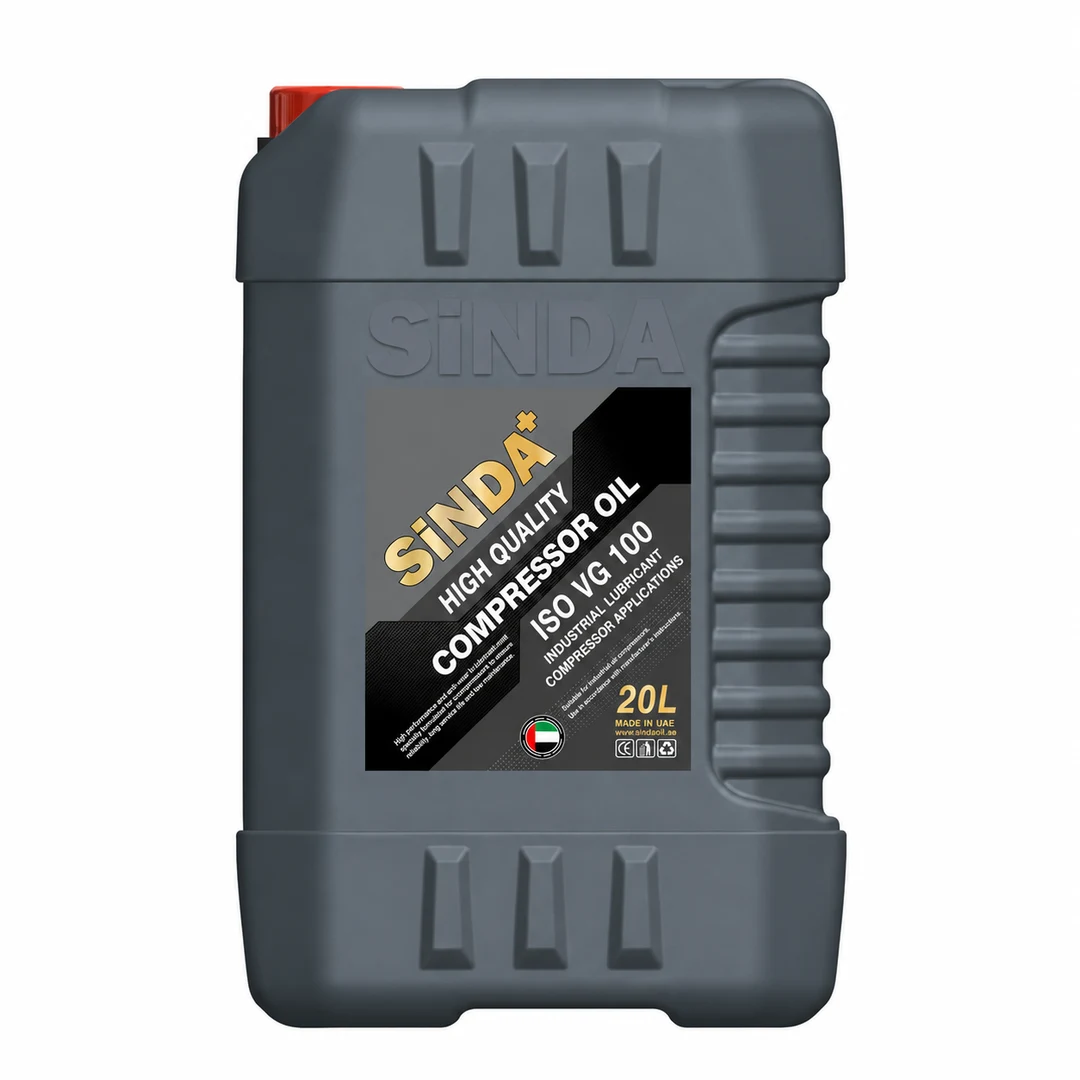
Compressor Oil 100
Compressor Oil 100 addresses compressor duties requiring a heavier ISO VG 100 lubricant. Confirm the lubrication point and startup conditions to achieve the intended film protection without restricting oil delivery or increasing unnecessary mechanical resistance.
- Product Type
- Key Performance
- Application
- Open this page on mobile
Product Overview
We supply Compressor Oil 100 for industrial enquiries where the compressor manufacturer specifies ISO VG 100. This grade requires particular attention to the relationship between operating film thickness and the lubrication system’s ability to distribute oil.
A heavier lubricant can meet the needs of a machine designed for it. In a system intended for a much lighter fluid, however, it can create additional resistance and affect startup delivery.
The product should therefore be evaluated against the compressor specification, rather than selected as a general response to high temperature, noise or age.
Operational Applications
Potential duties include compatible reciprocating air-compressor crankcases and cylinders, together with other compressor systems explicitly specifying ISO VG 100.
Identify each lubrication point before consolidating products. The crankcase oil and cylinder feed may have different requirements, particularly where the compression process exposes lubricant to elevated temperature.
For workshop or plant compressors with intermittent operation, startup conditions and condensation deserve attention alongside running temperature.
Our industrial lubricant portfolio provides the broader selection route when the requirement involves separate gearboxes, hydraulic equipment or other machinery rather than the compressor itself.
Performance Characteristics
Film formation: Appropriate operating viscosity supports separation at bearings, cylinders or other lubricated contacts. Oil delivery remains essential; a full reservoir cannot protect a surface that receives insufficient oil.
Hot-zone cleanliness: In relevant reciprocating duties, deposits can interfere with valve operation and discharge-system cleanliness. Oil selection and maintenance should address these locations together.
Mechanical resistance: Higher viscosity can increase drag and affect startup demand. A grade specified for one compressor should not be imposed on a different design to simplify inventory.
The practical outcome sought is consistent lubrication through startup, normal running and shutdown, with maintenance based on actual oil and machine condition.
Compatibility & Limitations
Do not replace an ISO VG 32 or VG 46 compressor fluid with Compressor Oil 100 without a documented change in the equipment requirement.
It is not a substitute for a dedicated refrigeration lubricant, oxygen-compatible fluid or breathing-air compressor oil. These applications require more than viscosity matching.
Check the existing base fluid before mixing or changing products. A previous synthetic fill can require a specific conversion procedure, even where the replacement has the same nominal grade.
Inspect oil-feed settings, filters and distribution passages during changeover. Changing lubricant does not correct a restricted lubrication system or a damaged metering device.
Compressor Oil 100 Selection Guidance
Select this grade when ISO VG 100 is specified for the exact compressor circuit and the proposed formulation satisfies its performance requirement.
For example, a reciprocating compressor may require VG 100 in its crankcase while an adjacent screw compressor uses VG 46. Combining both machines under the heavier grade can create an unsuitable operating condition in the screw compressor. Separate stock identification is the better purchasing decision.
Use this simple guide: choose the grade for the lubrication point, not for the plant as a whole.
Include the following in an enquiry:
- Compressor model and compression medium.
- Crankcase, cylinder or separate-circuit requirement.
- OEM specification and existing oil.
- Startup and running temperatures.
- Current maintenance interval and observed problems.
- Required quantity, pack preference and delivery location.
Compliance & Standards
ISO 3448 defines the grade classification. Compressor performance requirements can include DIN 51506 or appropriate ISO 6743-3 categories.
These classifications do not provide an automatic cross-reference between brands. Confirm the applicable performance statement and any mandatory approval in the selected formulation’s technical documentation before approving a replacement.
Industrial FAQ
Is Compressor Oil 100 equivalent to SAE 30 engine oil?
Do not substitute by approximate viscosity correspondence. Compressor suitability and additive requirements must also match.
Will thicker oil stop abnormal consumption?
It may alter consumption without resolving worn components, leakage or incorrect feed settings. Diagnose the cause first.
Can this grade be used in every piston compressor?
No. Piston design alone does not establish the required viscosity or lubricant performance.
Technical Specifications
| Selection parameter | Reference |
|---|---|
| Viscosity grade | ISO VG 100 |
| Nominal viscosity at 40°C | 100 mm²/s |
| Classification band at 40°C | 90–110 mm²/s |
| Viscosity test | ASTM D445 |
| Critical application input | Lubrication point and oil-feed method |
| Replacement requirement | Match chemistry and compressor performance |
The classification does not define every physical property. Compare the current formulation’s viscosity at 100°C, oxidation behaviour, deposit-control characteristics and material compatibility.
Temperature limits and drain intervals should be tied to the selected formulation and equipment duty.
Compressor Oil 100 belongs in equipment specifying ISO VG 100 and a compatible compressor formulation. Confirm the circuit, chemistry and oil-delivery conditions before ordering. Contact SiNDA with your technical requirement for a Dubai, UAE or export quotation: +971 56 154 4177.
For direct and secure purchases with guaranteed quality, contact our experts now and benefit from free consultation.