
Additive Packages
Combined chemistry for defined lubricant applications.
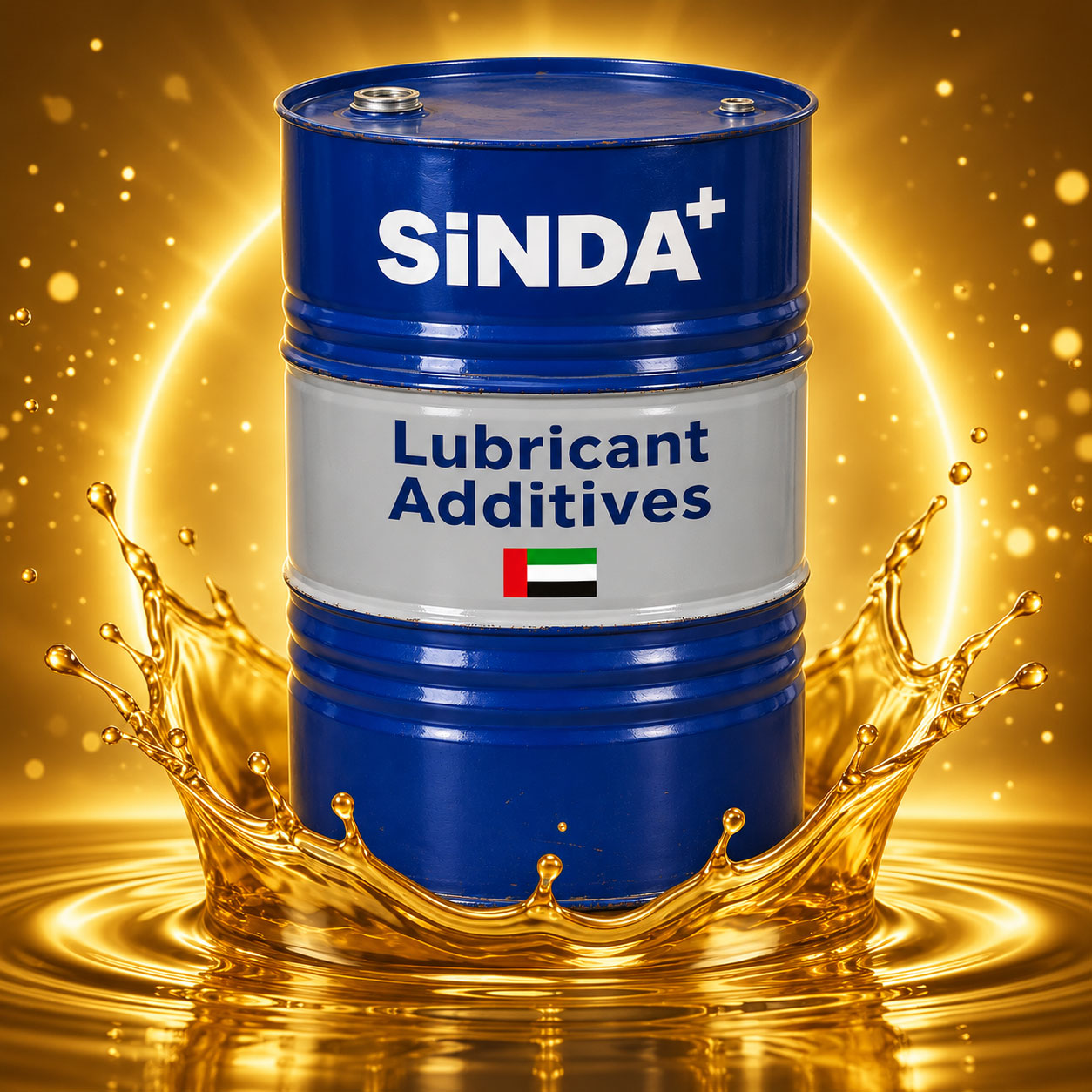
As a lubricant additives supplier UAE blenders can approach directly, SiNDA supplies components and additive packages for engine-oil and industrial-lubricant formulation through our Dubai sales team.
Send your target lubricant, base-oil system and performance requirements to request a suitable grade, technical documents and a quotation.
Our lubricant additive range gives formulation teams two purchasing routes: individual components for a defined function, and multi-component packages for an agreed application.
Explore detergent and dispersant systems, oxidation-control additives, antiwear and extreme-pressure components, friction modifiers and foam-control chemistry. Our engine-oil package range also includes Low SAPS packages for projects with controlled sulfated ash, phosphorus and sulfur requirements.
Start with the intended finished lubricant: passenger-car engine oil, heavy-duty diesel oil, industrial gear oil, hydraulic fluid or another specified application. Then identify the required function and the formulation evidence needed to support it.
Choose an additive family to explore products for your formulation.
Combined chemistry for defined lubricant applications.
Deposit control and reserve alkalinity.
Soot and sludge suspension for cleaner formulations.
Oxidation control for demanding service conditions.
Boundary wear and severe-load protection.
Friction control for application-specific requirements.
Protection against rust and metal corrosion.
Surface-foam control in lubricant formulations.
Improved low-temperature flow in suitable base oils.
For viscosity-temperature control, explore our viscosity index improvers and lubricant polymers.
| Function | Component or package route | Selection inputs | Product or technical route |
|---|---|---|---|
| Deposit control and acid neutralization | Detergent | Required TBN contribution, ash limits and base oil | Neutral or overbased calcium sulfonate |
| Soot and sludge management | Dispersant or detergent–dispersant system | Contaminant severity, engine duty and package balance | Detergent–dispersant packages |
| Oxidation control | Phenolic or complementary antioxidant system | Temperature, base-oil chemistry and oxidation target | Phenolic antioxidants |
| Boundary wear protection | Antiwear component | Application, metallurgy and phosphorus/ash constraints | Grade-specific AW selection |
| Scuffing and load protection | EP chemistry | Contact severity, sulfur activity and copper compatibility | Sulfurized olefin |
| Friction behaviour | Friction modifier | Required friction response and complete additive system | Application-specific FM selection |
| Rust and corrosion control | Inhibitor or metal deactivator | Metal type, water exposure and corrosion requirements | Application-specific inhibitor selection |
| Surface-foam control | Antifoam | Dispersion, dosage basis and air-release requirement | Silicone antifoam agents |
| Viscosity-temperature control | Viscosity modifier | Viscosity target, shear stability and base-oil response | Polymer selection route |
Also define the required low-temperature and water-response characteristics. A pour-point depressant addresses wax-related flow behaviour; an emulsifier and a demulsifier serve different oil–water requirements. State which behaviour the finished fluid needs before requesting a grade.
Detergents support surface cleanliness; overbased grades also provide reserve alkalinity for acid neutralization. Our range includes neutral calcium sulfonate and overbased calcium sulfonate.
Select by the required function, TBN, active content and carrier oil. Neutral does not automatically mean zero TBN, and a higher TBN does not establish suitability for every formulation. Detergent, metalworking and grease-feed grades can have different requirements.
Dispersants keep insoluble contamination, including soot and sludge precursors, distributed through the lubricant. Their role complements detergent action.
For engine-oil development, identify soot severity, base-oil polarity and the intended cleanliness requirements. Evaluate dispersancy within the complete formulation, including its interaction with detergents and other performance components.
Metal-containing detergents contribute to sulfated ash. An ashless dispersant component does not make the complete lubricant ash-free; assess the full formulation against its ash limits.
Antioxidants slow oxidative degradation that can contribute to acidity, viscosity change and deposits. Our phenolic antioxidants provide a product route for oxidation-control projects.
Specify the operating temperature, base-oil system and intended service conditions. Assess the selected chemistry through relevant finished-fluid oxidation tests, including complementary antioxidant combinations where the formulation requires them.
Antiwear additives protect contacting surfaces under boundary-lubrication conditions. EP additives address severe contact and scuffing requirements, while friction modifiers adjust frictional behaviour. These functions require separate selection criteria.
For sulfurized olefin, review sulfur activity and metal compatibility alongside load performance. Active-sulfur grades require particular attention where copper or brass is present. Total sulfur content alone does not establish EP performance or yellow-metal compatibility.
Formulation performance depends on the complete blend. Increasing one component can alter another function, so a higher treatment level is not an automatic improvement.
Build the evaluation around the actual base stocks, other additives, blending procedure and intended application. Record whether the base oil is virgin, re-refined or another documented feed, together with its viscosity and relevant quality data.
For foam-sensitive oils, distinguish surface foam from entrained air. Our silicone antifoam agents should be evaluated for dispersion and finished-fluid foam behaviour, with air release assessed separately where required.
Compare products on a clearly stated basis. A commercial concentrate may contain functional material and a carrier; its supplied addition rate is not necessarily the active concentration in the finished blend.
Calculation example: 2 kg of a hypothetical concentrate containing 50% active material by mass contributes 1 kg of active material. In a 100 kg final blend, that is 1% active content, although the supplied concentrate represents 2% of the blend.
This illustrates concentration accounting only; it is not a recommended treatment rate.
Choose the purchasing route according to the formulation responsibility and the documented scope of the product.
| Route | Suitable project starting point | What must be established |
|---|---|---|
| Individual component | A defined function within an existing formulation | Compatibility and complete-blend performance after the change |
| Functional package | Several related functions, such as detergency and dispersancy | Package scope and additional chemistry required |
| Complete performance package | A documented platform for a specified lubricant application | Supported base stocks, treatment level, supplementary additives and claim requirements |
Our detergent–dispersant packages combine related cleanliness functions. Their name describes that functional scope; the documentation must establish whether additional antiwear, antioxidant or other chemistry is required.
A complete package still requires the specified base oils and any separately required viscosity modifier or auxiliary components. Explore viscosity index improvers for polymer selection, shear stability and processing requirements.
An additive or package does not independently establish an API license or OEM approval for the finished lubricant. Use the supported formulation and the applicable testing, licensing or approval process for the claim being made.
Our Dubai sales team handles lubricant additive enquiries from blenders, manufacturers and distributors. Provide the exact product requirement, quantity and receiving location so the quotation can address the commercial and technical details together.
For each proposed grade, request confirmation of:
Manufacturer, product designation and country of origin.
Packaging, order quantity and availability.
Handling, storage and blending instructions.
Required documents, sample options and delivery timing.
For UAE procurement, contact the SiNDA sales team with the formulation brief and destination. International enquiries should also identify the destination country and any import-document or market-specific requirements.
SiNDA Oil Trading L.L.C. brings together UAE lubricant manufacturing experience and an international supply network serving customers across more than 23 countries. With over seven years in operation, we support lubricant manufacturers, industrial buyers and distributors through a portfolio spanning finished lubricants, base oils, additive components and polymers.
Our UAE lubricant blending and packaging operations combine modern production technology with integrated quality control and product traceability. This manufacturing background gives us a practical understanding of the relationship between base stocks, additive chemistry and finished-lubricant performance.
For additive buyers, that means a discussion built around the intended formulation: the required function, base-oil system, processing conditions and performance target.
From our Dubai hub, we coordinate additive enquiries for UAE customers and international markets. Product identity, origin, packaging, order quantity and delivery requirements form part of the procurement discussion, alongside the technical documents needed to evaluate the proposed grade.
Our portfolio connects individual additive components with functional packages, performance packages and complementary raw materials, helping buyers coordinate related formulation requirements through one commercial contact.
We work with customers developing new formulations, reviewing replacement materials and planning repeat purchases. Share your current grade or formulation brief with our team so the proposed supply can be assessed against your technical and purchasing requirements.
Send the target lubricant, intended specification, base-oil grades, viscosity target, proposed additives and relevant constraints. Include any limits on ash, phosphorus, sulfur, metals, colour or odour.
Before a blend trial, organise the documentation as follows:
| Document or data | Fields to request | Evaluation purpose |
|---|---|---|
| Grade-specific TDS | Product identity, properties, methods and recommended application | Establish the grade being evaluated |
| Concentration information | Active content, carrier and mass/volume basis | Compare concentrates and calculate additions consistently |
| SDS | Hazards, handling, storage and transport information | Plan material receipt and processing |
| Sample- or lot-specific COA | Batch identity, reported results, methods and acceptance limits | Check the material against agreed requirements |
| Formulation guidance | Treat rate, base-stock compatibility, blending order and temperature guidance | Define a reproducible trial |
| Performance support | Relevant tests, formulation scope and limitations | Assess the intended finished-lubricant claim |
The COA supports incoming material control; it does not replace finished-oil performance evidence. Agree the required test programme before scaling up, then retain the trial formulation and results alongside the grade documentation.
Start the trial record with blend appearance, sediment and storage stability. Add the required oxidation, corrosion, wear, foam, air-release or water-response tests according to the application; acceptance limits come from the target specification.
A component targets a defined function. A package combines several chemistries for an agreed purpose. Functional packages and complete performance packages can have different scopes, so confirm what the selected grade includes.
No. An additive contributes to formulation performance. The finished lubricant must satisfy the applicable formulation, testing and approval or licensing requirements.
Send the target lubricant, base-oil system, specification, required function, technical constraints, quantity and destination. Add the current grade or supporting documents when requesting a replacement.
Review the grade documentation, then run a controlled trial using the intended base oils and complete additive system. Check blend stability and the application-specific properties required by the finished-fluid specification.
Contact our Dubai sales team on WhatsApp to discuss additive selection, technical documents and supply requirements for your project.
Tell us the additive or package you need, the intended lubricant application, required quantity and delivery destination. For a replacement enquiry, include the current manufacturer and grade.
Attach the relevant TDS, specification or formulation requirements. Include your base-oil system and any limits on viscosity, ash, phosphorus, sulfur or metal compatibility that affect product selection.
Our team will review your enquiry and discuss the proposed grade, supporting documents, packaging and commercial requirements before you proceed with the order.
Start your enquiry with SiNDA on WhatsApp: +971 56 154 4177. Send your product requirement and destination to request additive documents and a quotation.
Request a Quote on WhatsApp →