
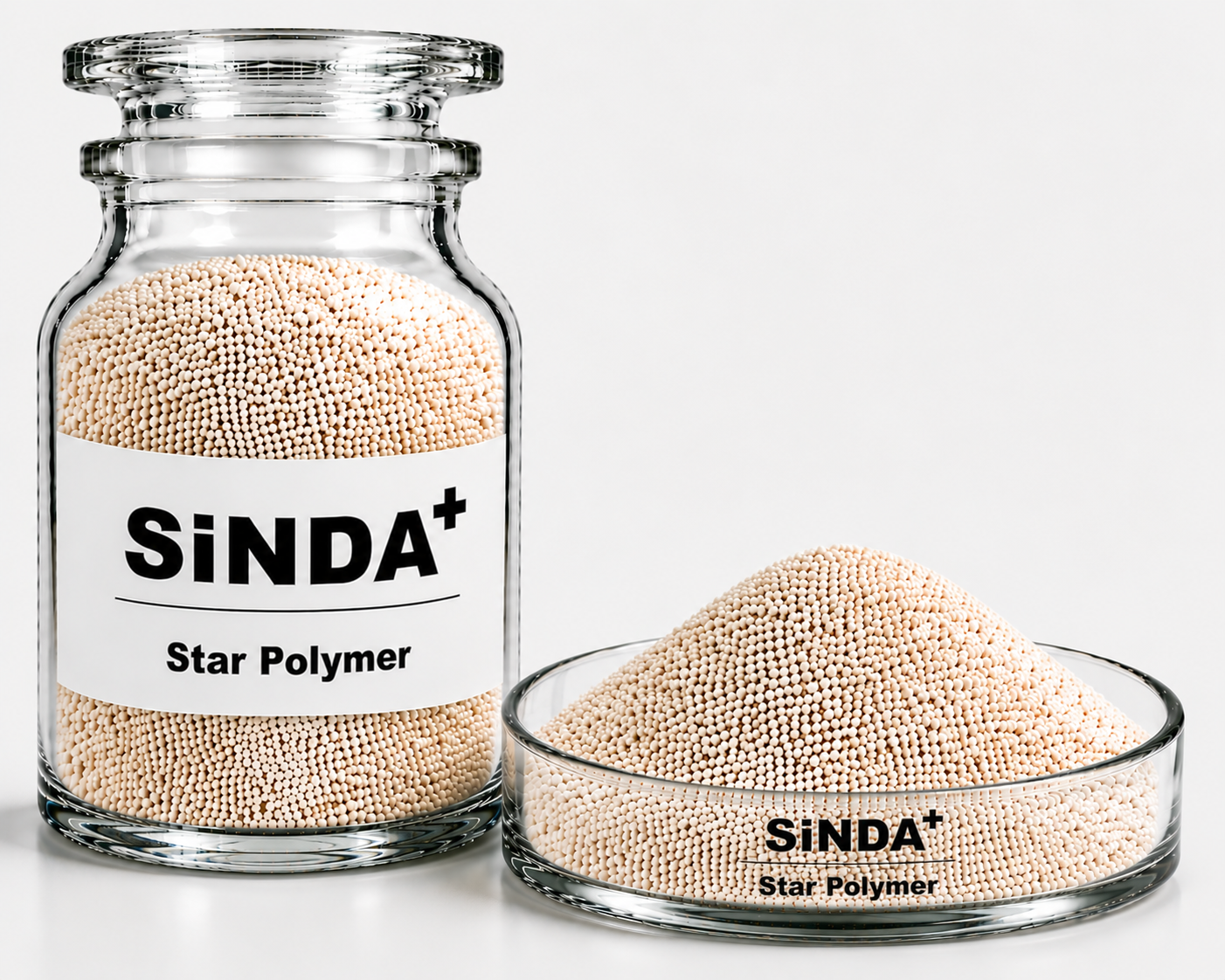
Star Polymer
Star Polymer (Multi-Arm) supplied by SiNDA as a branched polymer architecture for lubricant manufacturers developing viscosity modifiers requiring application-specific thickening efficiency, shear response, and rheological control.
- Polymer Architecture
- Key Performance
- Packaging
- Open this page on mobile
Product Overview
Advanced lubricant formulations increasingly rely on polymer architecture, not only polymer chemistry, to achieve the required balance between viscosity modification, shear stability, solubility, and finished-oil rheology.
Star Polymer (Multi-Arm) is a branched polymer architecture supplied by SiNDA through qualified international manufacturing partners for manufacturers developing viscosity modifiers and specialty lubricant additives.
Unlike a linear polymer architecture, a star polymer contains multiple polymer chains or “arms” connected to a central core. Depending on the specific chemistry and manufacturing route, the number of arms, arm composition, molecular weight, degree of branching, and core structure can be engineered to influence the polymer’s solution behavior and mechanical response.
Star-shaped polymers, including hydrogenated diene and styrene-diene architectures, have been developed for viscosity-index modification in lubricating oils, while other star architectures have also been investigated for lubricant rheology-control applications.
The compact multi-arm architecture can provide rheological behavior that differs from that of a comparable linear polymer. In practical formulation terms, this architecture provides an additional design variable for targeting specific combinations of viscosity modification and shear response.
Star Polymer should not be treated as a single fixed chemistry or universal lubricant additive. Final performance depends on arm chemistry, core design, degree of hydrogenation where applicable, molecular characteristics, carrier-fluid system, polymer concentration, and complete finished-lubricant formulation.
SiNDA supplies multi-arm star polymer technology for lubricant-additive development with available technical documentation, commercial shipment traceability where applicable, and international sourcing and supply support.
Key Benefits
- Multi-arm branched polymer architecture
- Suitable for viscosity modifier development
- Compact branched molecular structure
- Application-specific thickening performance
- Potential for improved shear-response control
- Grade-dependent polymer architecture options
- Suitable for application-specific lubricant formulation development
- Applicable to automotive and industrial viscosity-modifier systems
- Available technical documentation
- International supply through SiNDA
Operational Applications
Star Polymer (Multi-Arm) is intended for lubricant manufacturers and additive producers developing viscosity modifiers and specialty polymer systems requiring controlled rheological behavior.
Typical applications may include:
- Viscosity Index Improver production
- Passenger Car Motor Oils (PCMO)
- Heavy-Duty Diesel Engine Oils (HDEO)
- High-VI hydraulic fluids
- Transmission-fluid viscosity modifiers
- Industrial lubricant viscosity modifiers
- Specialty multigrade lubricant formulations
- Applications requiring defined shear-response characteristics
- Specialty polymer additive development
Star-polymer architectures have been developed and evaluated for viscosity-index modification and rheology control in lubricant applications.
Product suitability should be evaluated according to the specific star-polymer chemistry, number and composition of polymer arms, molecular weight, processing method, base-oil system, and finished-lubricant requirements.
Technical Overview
A multi-arm star polymer consists of several polymer chains connected to a central molecular core.
This architecture differs from a linear polymer structure because multiple polymer arms are connected through a central core rather than forming a single continuous chain.
Relevant architectural variables may include:
- Number of polymer arms
- Arm chemistry
- Arm molecular weight
- Total molecular weight
- Molecular-weight distribution
- Core chemistry
- Degree of branching
- Hydrogenation level, where applicable
- Styrene or diene content, where applicable
- Polymer concentration
- Carrier-fluid system
Core-crosslinked and other star-polymer architectures have also been investigated for viscosity modification, illustrating the role of polymer architecture as a design variable in lubricant rheology.
The practical effect of this architecture depends on the complete polymer design. Star polymers should therefore be selected on the basis of measured finished-lubricant performance rather than architecture alone.
Performance Characteristics
Viscosity Modification
Star polymers can be designed to modify the viscosity-temperature behavior of lubricant formulations.
Potential formulation outcomes include:
- Increased finished-oil viscosity index
- Multigrade viscosity control
- Application-specific thickening efficiency
- High-temperature viscosity contribution
Final viscosity performance depends on polymer chemistry, molecular weight, arm architecture, treat rate, base-oil solvency, and finished formulation.
Shear Response
Polymer architecture is one of the variables that can influence mechanical response under shear.
A multi-arm architecture may behave differently from a linear polymer of comparable overall molecular weight because polymer deformation and chain scission mechanisms depend on architecture.
Accordingly, shear performance should be evaluated using defined procedures such as:
- ASTM D6278
- ASTM D7109
- KRL methods
- OEM- or application-specific shear testing
A fixed SSI or PSSI value should not be published unless the exact grade, test method, reference blend, and calculation basis are defined.
Rheological Control
The compact structure of star polymers can influence hydrodynamic volume, solution viscosity, and thickening behavior.
This can allow formulators to balance:
- Thickening efficiency
- Shear response
- Polymer concentration
- Finished-oil viscosity
- Formulation stability
Polymer architecture is an important design variable in viscosity-modifier rheology and finished-lubricant behavior.
Low-Temperature Performance
Low-temperature behavior is not determined by star architecture alone.
Finished-lubricant performance depends on:
- Arm chemistry
- Base-oil composition
- Polymer concentration
- Additive package
- Finished viscosity grade
Where relevant, performance should be evaluated using CCS, MRV, pour-point, and low-temperature storage testing.
Compatibility & Limitations
Star Polymer compatibility depends strongly on chemistry and grade.
Depending on the polymer design, evaluation may include:
- API Group I base oils
- API Group II base oils
- API Group III base oils
- PAO-containing formulations
- Selected synthetic base-stock systems
Solubility, storage stability, finished-oil clarity, and rheological performance should be confirmed in the intended formulation.
Star architecture should not automatically be interpreted as meaning:
- Superior shear stability in every formulation
- Higher viscosity index than every linear polymer
- Universal base-oil compatibility
- Improved low-temperature performance
- Lower required treat rate
These outcomes must be demonstrated through grade-specific and finished-oil testing.
Selection Guidance
Star Polymer (Multi-Arm) may be suitable for manufacturers seeking:
- Multi-arm viscosity-modifier architecture
- Application-specific rheological control
- Tunable thickening efficiency
- Defined shear-response objectives
- Multigrade lubricant development
- Application-specific polymer additive systems
Before selecting a star polymer, manufacturers should evaluate:
- Target lubricant application
- Required finished-oil viscosity index
- Target viscosity grade
- Required shear stability
- Polymer arm chemistry
- Number of polymer arms
- Molecular weight
- Base-oil system
- Polymer treat rate
- Low-temperature requirements
- Finished-lubricant specification
The correct selection should be based on finished-lubricant performance rather than star architecture alone.
Compliance & Technical Documentation
SiNDA supplies Star Polymer (Multi-Arm) with available technical and commercial documentation to support product evaluation, supplier qualification, and procurement.
Available documentation may include:
- Technical Data Sheet (TDS)
- Safety Data Sheet (SDS)
- Certificate of Analysis (COA)
- Batch-specific quality documentation
- Polymer architecture information, where available
- Storage and handling recommendations
- Commercial shipment documentation
- Export documentation
Published typical values should not be interpreted as guaranteed specifications unless confirmed by the manufacturer’s current grade-specific TDS and batch-specific COA.
Why Choose SiNDA
SiNDA supports lubricant and additive manufacturers with access to specialty polymer technologies through qualified international manufacturing sources.
Key advantages include:
- Access to multi-arm polymer technologies
- Qualified international manufacturing partners
- Available technical documentation
- Commercial shipment traceability
- Support for product and grade evaluation
- Technical communication support
- Global logistics capability
- RFQ and procurement assistance
Frequently Asked Questions
What is a Multi-Arm Star Polymer?
A multi-arm star polymer is a branched polymer architecture in which multiple polymer chains are connected to a central core.
How is a star polymer different from a linear polymer?
A linear polymer consists primarily of one continuous chain, while a star polymer contains several polymer arms connected through a central structure. This difference can influence solution behavior, hydrodynamic volume, thickening efficiency, and shear response.
Are star polymers used as viscosity index improvers?
Yes. Hydrogenated star polymers and other star-shaped polymers have been developed and studied as viscosity index improvers for lubricating oils.
Does a star polymer automatically have better shear stability?
No. Shear stability depends on the complete architecture, molecular weight, chemistry, arm length, formulation, and test method. It must be measured for the specific grade.
Which lubricants can use star-polymer viscosity modifiers?
Depending on chemistry and grade, they may be evaluated in engine oils, hydraulic fluids, transmission fluids, industrial lubricants, and specialty multigrade formulations.
Is Star Polymer a specific chemical family?
Not necessarily. “Star Polymer” primarily describes molecular architecture. Depending on the specific product design, the arms and core may be based on different polymer chemistries. The applicable chemistry should therefore be confirmed from grade-specific technical documentation.
What documentation is available?
Depending on the manufacturing source and grade, SiNDA may provide TDS, SDS, COA, batch documentation, polymer information, storage guidance, and export documentation.
TDS
| Property | Test Method | Typical Value / Specification |
| Product Name | — | Star Polymer (Multi-Arm) |
| Product Category | — | Advanced Polymer Architecture |
| Product Type | — | Multi-Arm Star Polymer for Lubricant Additive Manufacturing |
| Primary Function | — | Viscosity Modification / Rheology Control |
| Commercial Brand | — | SiNDA |
| Manufacturer | Manufacturer Documentation | Qualified International Manufacturing Partner |
| Supplier & Distributor | — | SiNDA |
| Polymer Architecture | Manufacturer Declaration | Multi-Arm Star / Branched Polymer |
| Number of Arms | Manufacturer Method | Grade Dependent; typically ≥3 for multi-arm architectures |
| Core Structure | Manufacturer Declaration | Coupled or Crosslinked Central Core, Grade Dependent |
| Arm Chemistry | Manufacturer Declaration | Hydrogenated Diene, Styrenic-Diene, Methacrylate or Other Grade-Specific Chemistry |
| Physical Form | Visual | Solid Polymer, Crumb, Pellet or Oil-Soluble Concentrate — Grade Dependent |
| Appearance | Visual | Natural to Off-White Polymer or Clear-to-Amber Concentrate |
| Polymer Active Content | Manufacturer Method | Report Actual Result / Grade Dependent |
| Total Molecular Weight | GPC / SEC | Grade Dependent |
| Arm Molecular Weight | GPC / SEC | Grade Dependent |
| Molecular-Weight Distribution | GPC / SEC | Grade Dependent |
| Degree of Branching | Manufacturer Method | Multi-Arm Architecture; Grade Dependent |
| Degree of Hydrogenation | Manufacturer Method | Applicable Only to Hydrogenated Grades |
| Specific Gravity | ASTM D792 / ASTM D4052 | Grade and Product-Form Dependent |
| Solution / Concentrate Viscosity | ASTM D445 / Manufacturer Method | Grade, Concentration and Carrier-Fluid Dependent |
| Oil Solubility | Defined Dissolution Test | Pass under Specified Processing Conditions |
| Base-Oil Compatibility | Formulation Evaluation | Group I, Group II, Group III and Selected Synthetic Base Stocks — Validation Required |
| Thickening Efficiency | Defined Reference-Oil Test | Grade and Formulation Dependent |
| Viscosity Index Contribution | ASTM D2270, Finished Blend | Formulation Dependent |
| Shear Stability | ASTM D6278 / ASTM D7109 / KRL | Grade and Architecture Dependent |
| PSSI / SSI | Defined Shear Method | Report with Test Conditions |
| Low-Temperature Performance | ASTM D5293 / ASTM D4684 / ASTM D97, Finished Blend | Grade and Formulation Dependent |
| HTHS Contribution | ASTM D4683 / ASTM D4741, Finished Blend | Formulation Dependent |
| Pour-Point Response | ASTM D97 / ASTM D5949, Finished Blend | Grade and Base-Oil Dependent |
| Recommended Treat Rate | Formulation Guideline | Application and Grade Dependent |
| Recommended Processing Route | Process Guideline | Controlled Dissolution or Additive-Concentrate Manufacturing |
| Maximum Handling Temperature | Manufacturer Guideline | Grade Dependent; Confirm Manufacturer Limit |
| Recommended Applications | — | PCMO, HDEO, Hydraulic Fluids, Transmission Fluids, Industrial Lubricants and Specialty Multigrade Formulations |
| Storage Stability | Supplier / Internal Method | No Visible Separation or Polymer Degradation |
| Storage Conditions | Manufacturer Recommendation | Store Sealed in a Cool, Dry, Well-Ventilated Area |
| Shelf Life | Manufacturer Documentation | Subject to Grade-Specific Manufacturer Confirmation |
| Packaging | Supplier Declaration | SiNDA Commercial Packaging |
Final Technical Summary
Star Polymer (Multi-Arm) is a branched polymer architecture supplied by SiNDA for viscosity-modifier and specialty lubricant-additive development. Its multi-arm structure provides an additional design variable for controlling viscosity modification, rheological behavior, and shear response.
Final performance depends on polymer chemistry, arm architecture, molecular characteristics, treat rate, base-oil system, and finished-lubricant formulation and should be confirmed through application-specific testing.
Looking for Multi-Arm Star Polymer technology for viscosity-modifier development?
Contact the SiNDA technical team for grade information, technical documentation, product availability, samples, pricing, and RFQ assistance via WhatsApp.
For direct and secure purchases with guaranteed quality, contact our experts now and benefit from free consultation.