
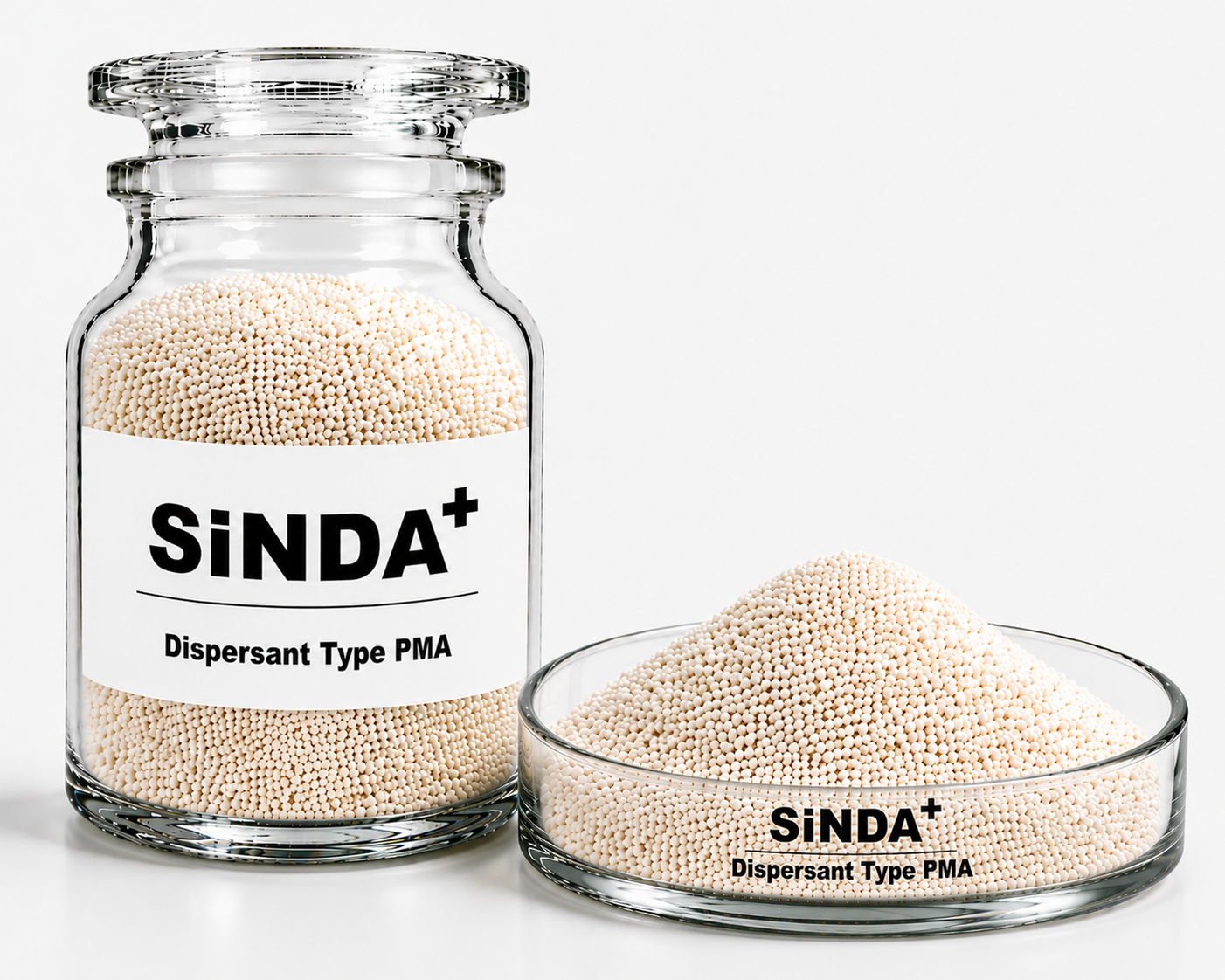
Dispersant Type PMA (D-VII)
Dispersant Type PMA (D-VII) is a functionalized polymethacrylate viscosity modifier supplied by SiNDA for lubricant manufacturers developing engine oils that require viscosity modification together with supplementary dispersant functionality.
- Dual Function
- Polymer Technology
- Packaging
- Open this page on mobile
Product Overview
Dispersant Type PMA (D-VII) is a functionalized polymethacrylate viscosity modifier developed for lubricant formulations requiring both viscosity modification and supplementary dispersant functionality.
Unlike conventional non-dispersant PMA viscosity modifiers, dispersant-type PMA technology incorporates functional chemistry intended to provide supplementary dispersant activity alongside viscosity modification. This multifunctional approach can allow a single polymer component to contribute to both viscosity-temperature control and contaminant-management objectives within the finished lubricant.
D-VII is primarily intended for automotive lubricant formulations where viscosity modification, shear behavior, low-temperature rheology, and supplementary dispersancy need to be considered together.
The product should not be treated as a complete detergent-dispersant package or as an automatic replacement for conventional ashless dispersants. Its actual contribution depends on the specific polymer chemistry, functionalization, treat rate, base-oil system, additive-package compatibility, and finished-lubricant performance requirements.
SiNDA supports product evaluation and procurement through available technical documentation, sample coordination, manufacturer communication, and international commercial supply, subject to grade availability and transaction-specific requirements.
Key Benefits
- Functionalized PMA viscosity-modifier technology
- Combines viscosity modification with supplementary dispersant functionality
- Designed for multigrade engine-oil development
- Potential to support contaminant-management objectives within the complete formulation
- Supports application-specific viscosity and rheology formulation objectives
- Designed for integration into modern engine-oil additive systems
- Supports multifunctional formulation strategies
- Technical documentation available, subject to manufacturing source
- International sourcing and commercial supply support through SiNDA
Lubricant Applications
Dispersant Type PMA (D-VII) is primarily intended for multigrade automotive engine-oil formulations where viscosity modification and supplementary dispersant functionality are evaluated within the same formulation system.
Potential applications may include:
- Passenger Car Motor Oils (PCMO)
- Heavy-Duty Diesel Engine Oils (HDEO)
- Multigrade gasoline engine oils
- Multigrade diesel engine oils
- Synthetic-blend engine oils
- Selected high-performance automotive lubricant formulations
Application suitability should be established within the complete formulation through relevant testing of viscosity characteristics, shear stability, low-temperature rheology, dispersant contribution, base-oil compatibility, and additive-package interactions.
Use in formulations targeting specific industry, OEM, or extended-service performance requirements should be validated against the applicable finished-lubricant specifications and test requirements.
Technical Overview
Dispersant Type PMA combines polymethacrylate viscosity-modifier functionality with chemically incorporated polar functionality intended to provide supplementary dispersant activity.
PMA viscosity modifiers influence lubricant viscosity-temperature behavior through the temperature- and solvency-dependent hydrodynamic behavior of polymer chains in the base-oil system. The resulting thickening contribution depends on polymer chemistry, molecular characteristics, concentration, and the solvency of the surrounding lubricant formulation.
In dispersant-type PMA technology, functional groups incorporated into the polymer can interact with polar oxidation products, soot-associated species, and other contaminants in ways that may support their dispersion within the lubricant. The extent of this contribution depends on the specific functional chemistry and complete lubricant formulation and should therefore be established experimentally.
Relevant variables include:
- Polymer molecular weight and molecular-weight distribution
- Functional monomer chemistry
- Degree or level of functionalization
- Polymer concentration and treat rate
- Carrier-fluid system
- Base-oil composition and solvency
- Additive-package chemistry
- Target finished-lubricant application
D-VII should therefore be evaluated as part of the complete lubricant system rather than on the basis of polymer type alone.
Performance Characteristics
Viscosity Modification
Dispersant Type PMA (D-VII) is designed to function as a polymethacrylate viscosity modifier in multigrade lubricant formulations.
Its contribution to viscosity-temperature behavior depends on the polymer grade, molecular characteristics, treat rate, base-oil system, and complete additive formulation.
Evaluation should consider the viscosity targets of the finished lubricant, including the requirements of the intended SAE viscosity grade and application. Final viscosity characteristics and viscosity index should be established in the complete finished-oil formulation.
Supplementary Dispersant Functionality
The functionalized PMA structure is designed to provide supplementary dispersant activity in addition to viscosity modification.
Depending on the specific polymer chemistry and finished formulation, this functionality may contribute to the management of soot-associated species, oxidation products, and other dispersed contaminants.
The magnitude of this contribution should be established through appropriate finished-oil testing. D-VII should not be positioned as a replacement for conventional ashless dispersants or a complete detergent-dispersant system unless formulation-specific performance data support that conclusion.
Shear Performance
The shear behavior of D-VII depends on polymer molecular characteristics, functionalization, treat rate, base-oil system, and finished-lubricant design.
Depending on the target application and specification, shear stability may be evaluated using methods such as ASTM D6278, ASTM D7109, or other applicable industry or OEM procedures.
Test results should always be interpreted in the context of the defined method, reference formulation, polymer concentration, and finished-oil viscosity requirements.
A fixed Shear Stability Index (SSI) value should only be published when the exact product grade, test method, reference blend, and calculation basis are clearly defined.
Base Oil Compatibility
Dispersant Type PMA (D-VII) should be evaluated for solubility and compatibility in the specific base-oil system used in the finished lubricant.
Compatibility can vary with base-oil composition, viscosity, solvency, polymer concentration, carrier fluid, additive-package chemistry, and blending conditions. Formulators should confirm homogeneous incorporation, storage stability, and finished-oil performance in the intended base-oil system before commercial production.
Low-Temperature Performance
PMA chemistry can be designed for different low-temperature rheological characteristics, but actual performance depends strongly on polymer architecture, treat rate, base-oil composition, additive-package chemistry, and the finished lubricant formulation.
Depending on the target lubricant specification, formulators may need to evaluate:
- Cold Cranking Simulator (CCS) viscosity
- Mini-Rotary Viscometer (MRV) performance
- Pour point
- Low-temperature storage stability
Testing should use the methods and acceptance criteria applicable to the intended finished-lubricant specification. Low-temperature performance should not be inferred from the PMA polymer family alone.
Compatibility & Limitations
Dispersant Type PMA (D-VII) is intended for lubricant formulations where viscosity modification and supplementary dispersant functionality are desired within the same polymer system.
Its final performance depends on:
- Polymer treat rate
- Base-oil composition
- Dispersant and detergent chemistry
- Antioxidant system
- Soot loading
- Target viscosity grade
- Shear requirements
- Low-temperature specifications
D-VII should not be marketed as an independent solution for deposit control, wear protection, oxidation control, or detergent performance. Those characteristics depend on the complete finished-lubricant additive system.
Selection Guidance
Dispersant Type PMA may be suitable for formulators seeking:
- Viscosity index improvement
- Supplementary dispersant functionality
- Multifunctional polymer technology
- Streamlined multifunctional formulation architecture
- Advanced multigrade engine oil development
- Flexible additive-package design
Before selection, formulators should define:
- Target SAE viscosity grade
- Target viscosity-temperature performance
- Desired shear stability
- Soot-handling requirements
- Low-temperature performance targets
- Base-oil system
- Conventional dispersant treat rate
- Finished-oil performance specifications
Laboratory formulation and performance testing are recommended before commercial production.
Compliance & Technical Documentation
SiNDA supplies Dispersant Type PMA (D-VII) through qualified international manufacturing partners with available technical and commercial documentation.
Documentation may include:
- Technical Data Sheet (TDS)
- Safety Data Sheet (SDS)
- Certificate of Analysis (COA)
- Batch-specific quality documentation
- Storage and Handling Recommendations
- Commercial Shipment Documentation
- Export Documentation
Published typical values should not be treated as guaranteed specifications unless confirmed in the current manufacturer TDS and batch-specific COA.
Why Choose SiNDA
SiNDA supports lubricant manufacturers with access to advanced multifunctional polymer additives through qualified international sourcing channels.
Key advantages include:
- Qualified international manufacturing sources
- Available technical documentation
- Coordinated commercial sourcing
- Shipment traceability
- Support for product evaluation
- Technical communication support
- Global logistics capability
- RFQ and procurement assistance
SiNDA’s role is to provide product access, documentation, commercial coordination, and technical support. Final formulation suitability should be established through the customer’s own testing program.
Frequently Asked Questions
What is Dispersant Type PMA (D-VII)?
D-VII is a functionalized polymethacrylate viscosity index improver designed to provide viscosity modification together with supplementary dispersant functionality.
How is D-VII different from conventional PMA?
Conventional non-dispersant PMA primarily provides viscosity modification, while D-VII incorporates functional groups that can also contribute to contaminant suspension and supplementary dispersancy.
Can D-VII replace a conventional dispersant?
Not automatically. Its dispersant contribution should normally be considered supplementary unless finished-oil testing confirms that a formulation can safely reduce conventional dispersant treat rate.
Which lubricants can use D-VII?
Typical applications include PCMO, HDEO, multigrade engine oils, and selected high-performance automotive lubricant formulations.
Does D-VII improve shear stability?
Shear stability depends on polymer design and formulation. It should be measured using a defined laboratory method rather than assumed from product type alone.
Is D-VII compatible with Group III base oils?
Compatibility with Group III base oils depends on the specific polymer grade, base-oil composition, treat rate, carrier fluid, and complete additive system. Solubility and finished-oil stability should therefore be confirmed through formulation testing.
What documentation is available?
Depending on the manufacturing source and batch, SiNDA may provide TDS, SDS, COA, batch documentation, storage guidance, and export documentation.
TDS
| Property | Test Method | Typical Value / Specification |
| Product Name | — | Dispersant Type PMA (D-VII) |
| Product Type | — | Dispersant Polymethacrylate Viscosity Index Improver |
| Chemical Family | Manufacturer Declaration | Functionalized Polyalkyl Methacrylate |
| Product Category | — | Multifunctional Lubricant Additive |
| Primary Function | — | Viscosity Index Improvement with Supplementary Dispersancy |
| Commercial Brand | — | SiNDA |
| Manufacturer | Manufacturer Documentation | Qualified International Manufacturing Partner |
| Supplier & Distributor | — | SiNDA |
| Physical Form | Visual | Oil-Soluble Polymer Concentrate |
| Appearance | Visual | Clear to Slightly Hazy Yellow-to-Amber Viscous Liquid |
| Color | ASTM D1500 | ≤ 2.0 |
| Density @15.6°C | ASTM D4052 / Equivalent | 0.91–0.93 g/cm³ |
| Specific Gravity @15.6/15.6°C | ASTM D4052 / Equivalent | Approx. 0.915 |
| Kinematic Viscosity @40°C | ASTM D445 | 10,000–15,000 mm²/s |
| Kinematic Viscosity @100°C | ASTM D445 | 700–1,000 mm²/s |
| Flash Point, PMCC | ASTM D93 | ≥120°C |
| Polymer Active Content | Manufacturer Method | Grade Dependent |
| Functionalization | Manufacturer Method | Dispersant-Functional Methacrylate Polymer |
| Thickening Efficiency | Defined Reference-Oil Test | Moderate to High |
| Viscosity Index Contribution | ASTM D2270, Finished Blend | High; Formulation Dependent |
| Shear Stability | Bosch / KRL / Sonic / ASTM D6278 | Grade Dependent |
| PSSI | Defined Shear Method | Grade Dependent; Report Test Condition |
| Dispersancy Performance | Bench / Finished-Oil Evaluation | Supplementary; Formulation Dependent |
| Cleanliness Contribution | Finished-Oil Evaluation | Supports Cleanliness Performance |
| Low-Temperature Performance | ASTM D5293 / ASTM D4684, Finished Blend | Formulation Dependent |
| Oil Solubility | Internal Compatibility Test | Pass |
| Base-Oil Compatibility | Formulation Evaluation | Group I, Group II and Selected Hydrocracked / Group III Stocks — Validation Required |
| Recommended Treat Rate | Formulation Guideline | Grade and Application Dependent |
| Maximum Handling Temperature | Process Guideline | 100°C |
| Recommended Applications | — | PCMO, HDEO, ATF, MTF, CVT, Tractor Fluids and Sel |
Final Technical Summary
Dispersant Type PMA (D-VII) is a functionalized polymethacrylate viscosity index improver supplied by SiNDA, combining viscosity modification with supplementary dispersant functionality for advanced engine-oil formulations.
Final shear stability, dispersant contribution, low-temperature performance, and base-oil compatibility should be validated in the complete finished-lubricant formulation.
Looking for Dispersant Type PMA (D-VII) with technical documentation and product evaluation support?
Contact the SiNDA technical team for pricing, availability, samples, technical information, and RFQ assistance via WhatsApp.
For direct and secure purchases with guaranteed quality, contact our experts now and benefit from free consultation.